


Book Review: Real Food for Pregnancy: The Science and Wisdom of Optimal Prenatal Nutrition by Lily Nichols
Reviewed by: Abbie Tomson, NHS Continuity of Carer Midwife and All4Birth Digital Lead
Published: 2026
Author: Rhea Dempsey
Publisher: Boathouse Press
ISBN: 9780987402929
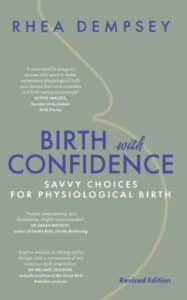
I was particularly excited to read the second edition of Birth with Confidence.
I had only recently read the first edition, having been recommended it by Sheena Byrom while I was preparing for my own second birth. So when I was given the opportunity to read the updated edition before its formal release, it felt like very good timing.
Rhea Dempsey’s work has been influential in the world of birth preparation for many years, and Birth with Confidence is a book with a very clear philosophy: supporting women to understand the conditions that can help physiological birth unfold, while developing the knowledge and confidence to navigate their individual birth experience.
The second edition retains the heart of the original book, but brings it up to date with new research, updated statistics and additional birth stories. There is also noticeably more discussion around epidural analgesia than in the first edition, something Rhea herself acknowledges reflects its increasing popularity.
I actually really appreciated this addition.
The reality is that epidurals are an important part of contemporary maternity care and many women will consider, request or have an epidural during their labour. Having more discussion around this makes the second edition feel more reflective of the births women are actually experiencing today, rather than presenting physiological birth and epidural birth as completely separate worlds.
At the heart of Rhea’s approach is the idea that confidence in birth is not simply about believing that your body can give birth. It is about understanding the environment in which birth takes place, considering the people around you, knowing what supports physiological labour, and being able to make informed decisions as circumstances change.
This is one of the things I love most about the book.
Rhea talks extensively about the conditions that support physiological birth — including continuity of care, the birth environment, supportive relationships, freedom of movement, privacy, safety and the way we understand and respond to pain. She also explores the influence that partners, family members and healthcare professionals can have on a woman’s confidence.
Her concept of the “savvy willing woman” is particularly interesting. The intention isn’t simply to tell women to be confident or to convince themselves that they can have a particular type of birth. It is about becoming informed about birth and the maternity system, understanding your options and surrounding yourself with people who can support you.
As a midwife, I find this incredibly valuable.
We talk a lot about informed choice, but informed choice requires more than being given a list of interventions. It means having the opportunity to understand your options, consider the benefits and drawbacks, recognise what matters to you and have meaningful conversations about what happens if circumstances change.
And I think this is an important point to make about Birth with Confidence.
This is not a book about achieving a “perfect” birth.
Nor should reading it leave a woman feeling that choosing an epidural, having an induction, needing assistance or having a caesarean birth means that she somehow lacked confidence.
I have seen some criticism of the language around physiological birth and “confidence” suggesting that it could feel patronising or imply that women who have interventions have somehow failed. I think it is important to read Rhea’s work in the context of what she is actually trying to achieve: helping women who want to understand and prepare for physiological birth to recognise the factors that can support it.
That distinction matters.
Women deserve information about physiological birth without being made to feel guilty for the choices they make.
They deserve to know that their birth may unfold differently from what they hoped for without that becoming a reflection of their strength, preparation or worth.
And they deserve to be able to choose pain relief — including an epidural — without that choice being framed as a failure of confidence.
I think the second edition does a good job of acknowledging this wider reality, particularly through its expanded discussion of epidurals.
Another concept I particularly appreciated is Rhea’s discussion of the “crisis of confidence” in labour. There can be a point in labour where a woman suddenly thinks I can’t do this. Understanding that this can be a normal part of the experience can be incredibly reassuring.
It also highlights the importance of the people around a birthing woman. When someone is in that moment of doubt, the response of the person supporting them can make a huge difference. Having someone who understands what is happening and can calmly remind you that you are capable of getting through the next contraction, rather than immediately interpreting distress as evidence that something is wrong, can be enormously powerful.
I also love that Rhea doesn’t reduce birth preparation to breathing techniques and positive affirmations. Those things can absolutely be useful, but confidence comes from much more than that.
It comes from knowledge, preparation, relationships, environment, autonomy and feeling supported.
The updated edition is therefore a welcome addition to the birth preparation literature. It retains the philosophy that has made Rhea’s work so influential while incorporating newer evidence, updated statistics and more contemporary discussion around the choices women are making.
For me, the greatest value of this book is that it encourages women to become savvy about birth.
Not blindly confident.
Not fearful.
Not committed to achieving a particular birth at all costs.
But informed, thoughtful and prepared to participate actively in the decisions surrounding their care.
And I think that is something worth encouraging regardless of how a woman’s birth ultimately unfolds.
Birth with Confidence is a book I would recommend to pregnant women who are interested in physiological birth, but also to partners, doulas, birth educators and maternity professionals. Even if you don’t agree with every aspect of Rhea’s philosophy, it provides plenty to think about and challenges us to examine the assumptions we bring to birth.
Having read the first edition only recently, I was particularly pleased to see how the second edition has evolved rather than simply being a reprint with a new cover. The additional research, stories and expanded discussion of epidurals make it feel relevant to the maternity landscape women are navigating today.
For me, this is ultimately a book about confidence without coercion.
About giving women more understanding of birth, not less.
About recognising the conditions that can support physiological birth while accepting that birth is unpredictable.
And about helping women feel informed and supported enough to navigate whatever their birth ultimately asks of them.
That is a message I can wholeheartedly get behind.